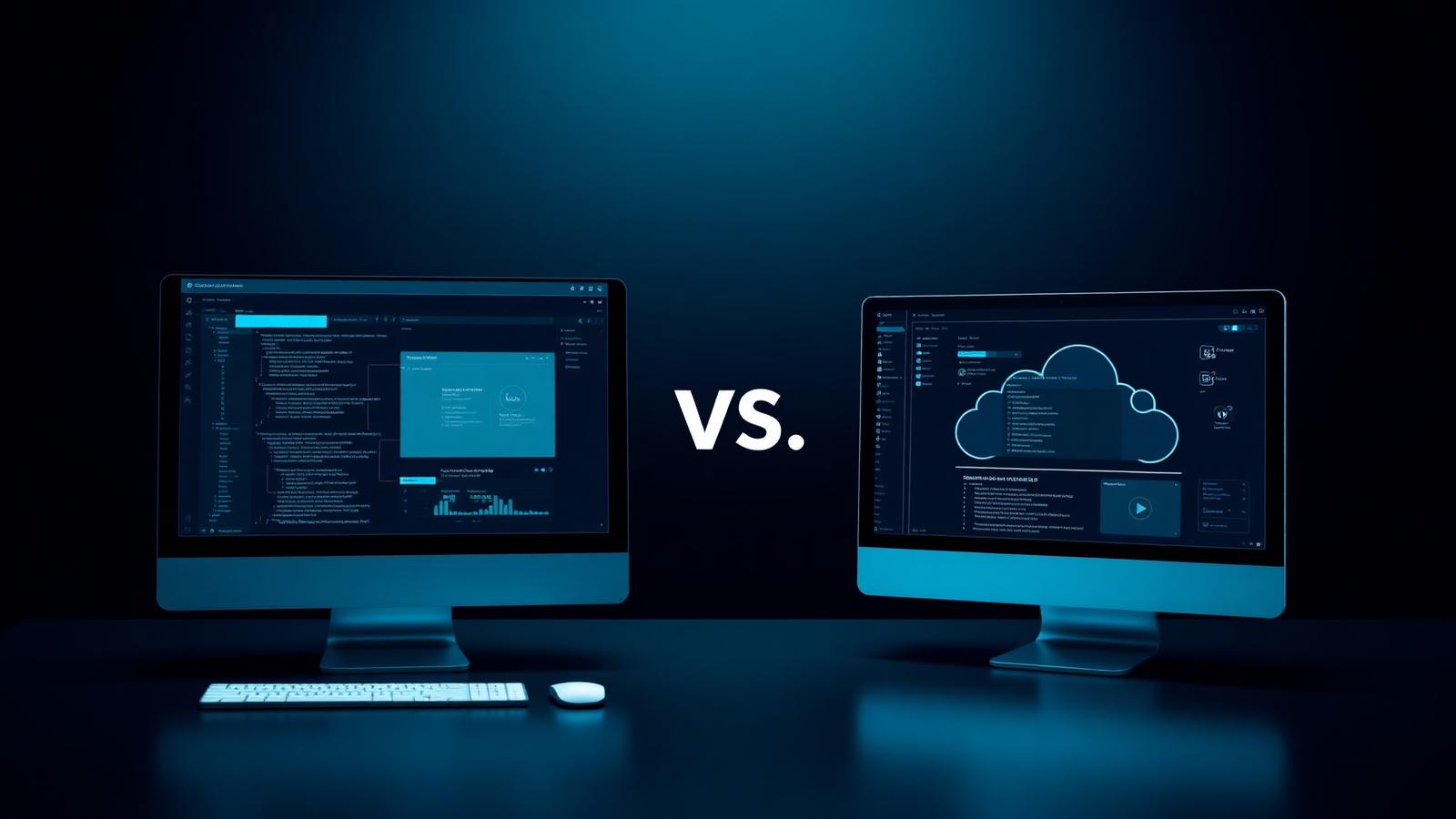
Every growing business eventually faces the same question: should we keep stacking SaaS subscriptions, or invest in custom software development built around how we actually work? The answer isn't universal. It depends on your workflows, growth trajectory, data sensitivity and long-term strategy. Getting it right can save years of friction; getting it wrong locks you into someone else's roadmap.
SaaS is fantastic when your needs match the product. But as companies scale, unique processes, integrations and competitive differentiation quickly outgrow generic tools. Rising per-seat pricing, vendor lock-in and workflow limitations become the tax you pay for choosing convenience over ownership.
This article compares SaaS and custom software across the dimensions that actually matter: cost, scalability, ownership, security and integrations, so you can make a confident, strategic decision.
What Is SaaS?
Software-as-a-Service is subscription-based software hosted by a vendor and accessed through the browser or an API. Familiar examples include Salesforce, HubSpot, Shopify, Slack, Notion and QuickBooks. You pay monthly or annually, typically per user, and the vendor handles hosting, updates and infrastructure.
The upside: fast time-to-value, no maintenance overhead, and continuous product updates. The trade-off: you adapt your business to the tool, not the other way around.
What Is Custom Software?
Custom business software is engineered around a single organization. That might be a bespoke CRM, an ERP tailored to real operations, a POS built for a specific retail model, an internal admin, a customer portal, or an automation platform shaped by how a team actually works. You own the source code, the data and the roadmap. Zynvora's portfolio shows the range, from custom CRM software and ERP software to industry-specific automation platforms.
Cost Comparison
For a small team of five, SaaS almost always wins on total cost. Once a company reaches around fifty people running more than twenty overlapping subscriptions, a consolidated custom platform tends to pay for itself within eighteen to twenty-four months.
Scalability and Flexibility
SaaS handles scale gracefully as long as the product still fits your workflow. The moment your differentiators start living outside its defaults, you spend more time engineering around the tool than benefiting from it. Custom software adapts to your operating model and grows without the per-user penalty that SaaS pricing enforces.
Ownership and Data Control
With SaaS, the vendor owns the platform and controls the roadmap, pricing and data portability. Custom software puts you in charge: source code, database, integrations and product direction are all yours. That translates to zero vendor lock-in and full control over your competitive edge.
Security and Compliance
Regulated industries such as healthcare, education, finance and government often need certifications, audit trails, data residency and access controls that generic SaaS can't offer. Custom software allows you to align security architecture with your compliance obligations (HIPAA, PCI-DSS, GDPR, SOC 2) rather than hoping a vendor's defaults are enough.
Integration With Existing Systems
Most businesses run on a patchwork of tools that never quite talk to each other. A typical stack spans CRM, ERP, POS, accounting, inventory and marketing platforms, each holding a slice of the truth. Custom software can integrate deeply with all of them through APIs, webhooks and event buses, creating a single source of truth. SaaS integrations exist, but they are limited to what the vendor chooses to expose and tend to break at scale.
When SaaS Is the Better Choice
- Your workflow is genuinely standard (email, docs, basic accounting)
- You need speed-to-launch more than long-term flexibility
- You have a small team and predictable, low-volume usage
- The tool is not a source of competitive differentiation
- You don't want to manage infrastructure or updates
When Custom Software Is the Better Choice
- Your processes are a competitive differentiator
- Per-seat SaaS costs are outpacing revenue growth
- You need deep integrations across CRM, ERP, POS or inventory
- Data sensitivity or compliance rules out generic vendors
- You want ownership of source code, data and roadmap
- You are consolidating half a dozen or more overlapping tools into one platform
Decision Matrix
Frequently Asked Questions
Is custom software always more expensive?
Upfront, yes. You're funding a build instead of a subscription. Over 3 to 5 years, however, custom software often costs less than accumulating SaaS seats, especially when it consolidates multiple tools.
Can SaaS be customized enough for growing companies?
Some SaaS platforms offer deep customization via APIs, workflows and plugins. But you're still bound to the vendor's roadmap, data model and pricing changes.
Who owns the data in a SaaS platform?
Typically the vendor hosts the data and grants you access under license terms. Data export is possible but rarely seamless, which becomes a real problem during migrations.
How long does custom software development take?
A focused MVP can ship in 8 to 14 weeks. Full enterprise platforms with multi-role dashboards, integrations and reporting usually run 4 to 9 months, delivered in staged releases.
Can custom software integrate with ERP and CRM systems?
Yes. Modern custom software is API-first and can integrate with Salesforce, HubSpot, SAP, Odoo, Zoho, QuickBooks and virtually any system that exposes an API or webhook.
Final Recommendation
SaaS is the right choice for speed, simplicity and standard workflows. Custom software is the right choice for competitive advantage, deep automation and long-term ownership. Most successful businesses eventually adopt both: SaaS at the edges for commodity workflows, and custom software at the core for the processes that define how they win.
The strategic question isn't "custom or SaaS?". It's "which parts of our business deserve to be uniquely ours?" That's where a software development company should help you draw the line. If you'd like a second opinion on your current stack, our team can review your workflows and recommend the highest-leverage move.